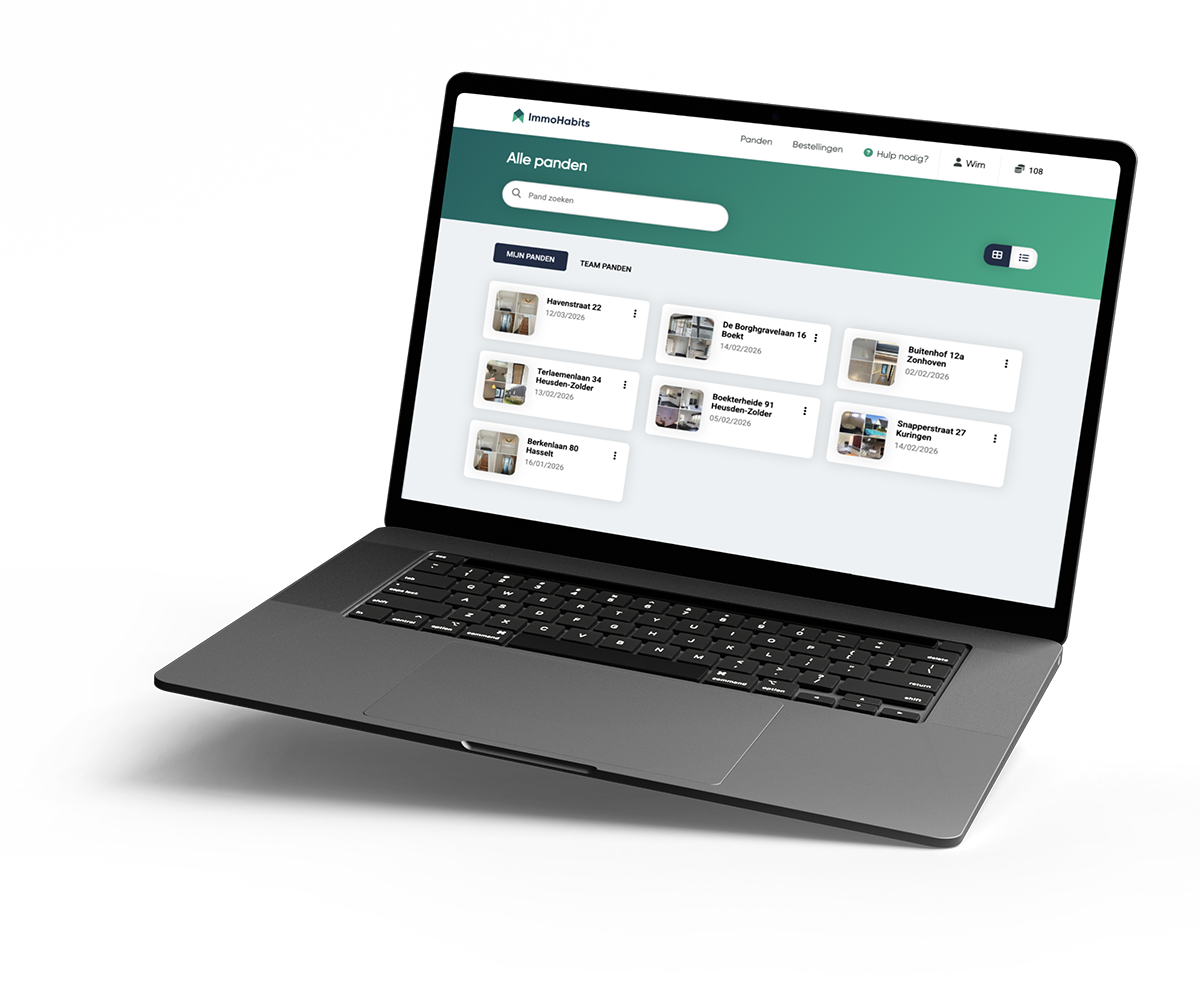
Create your own report in 2 minutes?
Take photos, AI writes the report. Your first test report is free.


Yes. The law sets no requirements for how an inspection report is produced, only for the result: it must be detailed, drawn up adversarially, and dated and signed by both parties. An inspection report written by AI and then reviewed and signed by the parties meets those requirements just as well as a handwritten document or one drawn up by an expert.
The Belgian regional lease legislation (and article 1730 of the old Civil Code on which it builds) sets four substantive conditions:
Nowhere is there a requirement about the tool: pen and paper, a Word template, an expert or AI software. The law is neutral about the method; what counts is that the end result meets the four conditions.
"Adversarial" is about the role of the parties, not about who types the text. With an expert too, one person writes the document; it becomes adversarial because both parties are involved in the inspection, approve the result and sign it.
With an AI inspection report it is identical: the photos are taken on site (ideally with both parties present), the AI turns them into a structured report, and a human checks, corrects and finalises. Only after both parties sign does the document become final. The AI is a writing aid; the legal act remains entirely with the parties.
That depends on the quality of the input and the software, exactly as with a human author. A good AI report describes per room the floors, walls, ceilings, joinery and appliances present, names visible damage and references the matching photos. Because every finding is linked to a dated photo, the evidential value is in practice often stronger than a brief typed report without images.
Note: the user remains responsible for completeness. Photograph every room fully, including meters and details, and review the generated report before finalising it.
The presumption of article 1731 of the old Civil Code then applies: the tenant is deemed to have received the property in the condition it is in at the end of the lease. The burden of proof reverses entirely, to the landlord's disadvantage. To claim tenant damage, you have to prove the property was in a different state at move-in, without a document to show it.
Note that a report which is too vague does not count. Wording such as "received in good condition" is treated by the courts as equivalent to having no report at all, and a unilaterally drawn up document carries no evidential weight when the adversarial element was missing. That is exactly why detail is not a luxury: it is what gives the document its value.
Yes. Within the EU, the eIDAS regulation provides that an electronic signature may not be denied as evidence solely because it is electronic. A qualified electronic signature (for example via eID or itsme in Belgium) has the same legal value as a handwritten one. An inspection report may therefore be signed and stored digitally.
Both are legally valid; the difference lies in cost, speed and who does the work. An expert quickly costs a few hundred euros per report and must be scheduled; doing it yourself with AI software costs a fraction of that and the report is ready in minutes. When a conflict is foreseeable (for example a difficult relationship between the parties), an independent expert can still be the better choice: that independence then outweighs the price. For the vast majority of rentals, a detailed AI report signed by both parties is more than sufficient.
Is an inspection report consisting only of photos valid?
Photos alone do not constitute a detailed inspection report: a descriptive document signed by both parties is required. Photos are, however, the strongest possible support for that document.
Does the tenant have to be present when the photos are taken?
It is the safest approach: the adversarial character is then guaranteed automatically. If not possible, have the tenant expressly approve and sign the finished report before or at the key handover.
Will the justice of the peace accept an AI inspection report?
The judge assesses whether the document is detailed, adversarial and signed, not which software created it. A precise, signed report with dated photos is strong evidence.
Who is responsible if the AI misses something?
The parties themselves: they check and sign the report. So always review the generated document and add to it where needed, just as you would proofread an expert's report.
Take photos, AI writes the report. Your first test report is free.